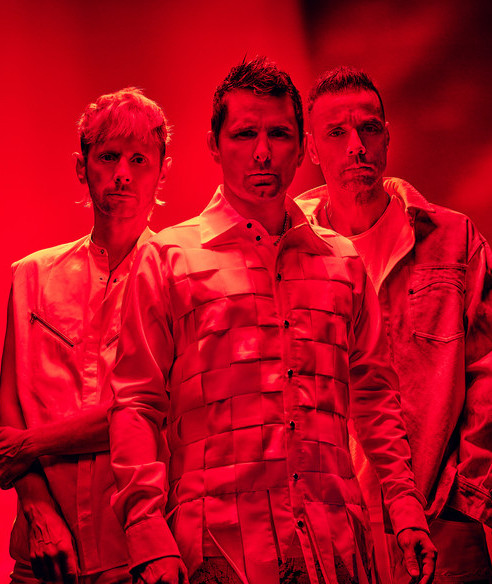
On the run
I put on MUSE expecting a workout playlist and got a physics lesson instead. Nineteen tracks, one band—Muse, from Teignmouth, Devon—building an entire cosmology across 24 years by treating each album not as reinvention but as pressure escalation. Origin of Symmetry in 2001, Absolution in 2003, The 2nd Law in 2012, all the way through 2025's "Unravelling": the same three musicians adding one layer of orchestral maximalism, one geopolitical grievance, one borrowed genre per record until the architecture collapsed under its own ambition and had to be rebuilt from scratch.
The structural choice, repeated on every album, was to embed the breakdown inside the build—not verse-chorus-verse but ignition, overload, collapse, restart. Which is why "Isolated System" opens this playlist at near-stillness and "Knights of Cydonia" closes it at full gallop: the arc isn't a curator's sequencing trick, it's the band's entire argument about how systems fail and what survives.
Running to this at 113 BPM average—slower than most workout playlists, unconventional for anything claiming to fuel a run—you realize the tempo isn't the point. The pressure curve is. "Hysteria" off Absolution builds on Chris Wolstenholme's bass line like a fault line cracking open. "Stockholm Syndrome" from the same record doesn't resolve, it detonates. "Plug in Baby," recorded at Ridge Farm Studios in 2001, is three minutes of Matthew Bellamy's falsetto and fuzz pedal doing what Queen did in the '70s: treating rock songs like opera without irony.
Eighty minutes is a long time to spend inside one band's architecture. Most playlists would splice in relief, a tempo shift, a different voice. MUSE doesn't. It asks whether you're still standing when the next system comes online. By the time "Knights of Cydonia" hits—full gallop, Ennio Morricone Western strings over a glam-metal stomp—you're not pacing yourself against tempo. You're pacing yourself against the band's refusal to ease off.
I've run to plenty of playlists that lie about how far you have left. This one doesn't. It tells you exactly what Muse has been telling us since Origin of Symmetry: the only question is whether the structure holds or whether it collapses and you start over.
From the coach
Pace the pressure curve, not the tempo
Warm up slow. Tracks 1–3 sit around 108 BPM, well below conversational pace. Let your heart rate settle into zone 2. Do not chase the beat yet. You're building the base before the pressure starts.
Track 4 drops to 98 BPM—this is active recovery inside the run. Hold easy effort even as the music swells. By track 7 the BPM jumps to 121. Open your stride here. Let the tempo pull your turnover up without forcing it. This is where the run begins.
Tracks 10–12 drop back to 112. Recover again. Then track 13 hits 129 BPM and holds through 15—this is your threshold block. You're now past halfway.
Track 16 is your wall breaker. You'll hit cognitive fatigue before your legs fail. The tempo stays high but the song's structure gives you a cue: when the breakdown hits, reset your breathing. Two-count inhale, two-count exhale. Anchor to that.
Tracks 17–18 hold at 123. Finish strong. Track 19 drops to 75—walk it out, let your heart rate fall.
FAQ
- How should I pace a run to this playlist?
- Start easy through 2012 and 2022: The Bookends—let the low pressure build. When you hit Drones into Absolution, settle into your rhythm; Wolstenholme's bass on 'Hysteria' will lock you in. The Geopolitical Grievance Section is your mid-run anchor. By Absolution into The Resistance into Origin, you're not pacing tempo anymore—you're pacing pressure. Let The Collapse and the Outro bring you down without stopping the momentum.
- What kind of run is this playlist built for?
- Long, steady efforts—10K to half-marathon pace, maybe a recovery long run where you're not chasing speed. Eighty minutes is too much for a tempo workout, and 113 BPM average means this isn't interval fodder. This is endurance music: it asks whether you can sustain inside one band's architecture without needing relief. If you're used to genre-hopping playlists, this will feel claustrophobic. That's the point.
- Why is the BPM so low for a running playlist?
- Because Muse doesn't write to cadence—they write to pressure. 113 BPM average means you're not chasing the beat; you're riding the build. 'Hysteria' feels faster than its tempo because of the bass line's momentum. 'Stockholm Syndrome' doesn't need high BPM to demand everything from you. The playlist teaches you to pace against intensity, not tempo, which is a better skill for distance running anyway.
- What makes 'Stockholm Syndrome' the key moment?
- 'Stockholm Syndrome' is where the playlist stops negotiating. Recorded for Absolution in 2003, it's Muse's orchestral ambition and metal brutality colliding without apology. By the time you're two-thirds through the run, you're inside the pressure curve—not fresh, not broken. The track gives you three climaxes, none resolved. You either stay in or stop. At that point in the run, that binary is exactly what you need.
- Why run to a single-band playlist?
- Because MUSE isn't a singles playlist—it's an argument. Muse spent 24 years building the same cosmology: ignition, overload, collapse, restart. Running to nineteen tracks from Origin of Symmetry through Unravelling, you hear the architecture hold and break and rebuild. Most playlists give you variety to keep you distracted. This one gives you depth. If you know the albums, you're running through Muse's entire career. If you don't, you're learning what one band sounds like when it refuses to stop escalating.
- Is this playlist good for a first-time Muse listener?
- Honestly? No. If you've never heard Muse, start with Black Holes & Revelations or Absolution front-to-back, not a playlist. MUSE is for runners who already know what 'Plug in Baby' sounds like live, who've heard 'Knights of Cydonia' close a festival set. This playlist assumes you're in on the argument. If you're not, it'll just sound like bombastic rock at weird tempos. But if you are? This is the only way to run to Muse.